Data lake concept and systems: a survey
Abstract
reviews the development, definition, and architectures of data lakes
provide a comprehensive overview of research questions for designing and building data lakes
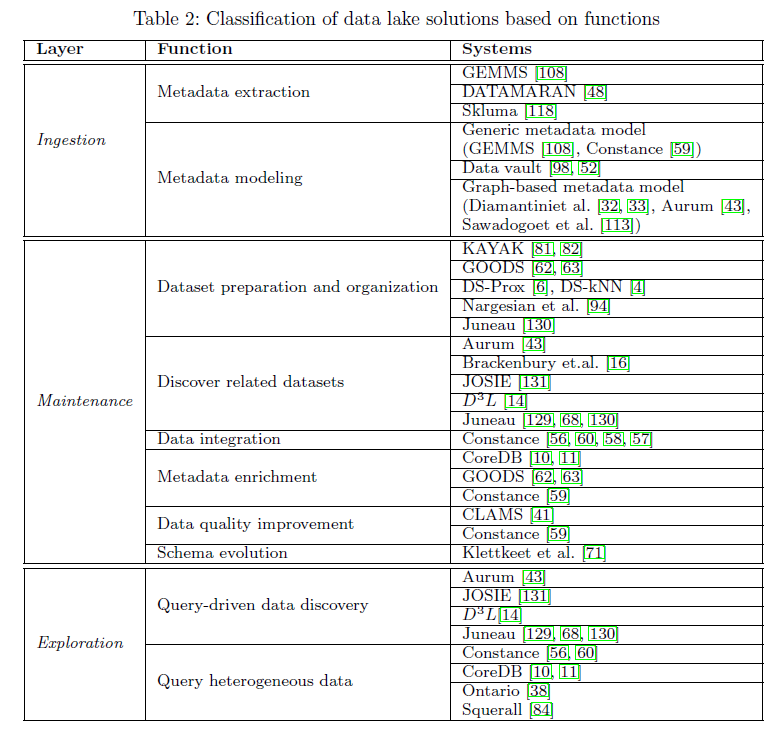
classify the existing data lake systems based on their provided functions
1 Introduction
Big data -> ELT, NoSQL -> data lakes
2 A brief history of data lakes
- 2010-2013: Beginnings
- 2014-2015: Criticisms and further development
- 2016-present: Prosperity and diversity
3 Data lake definition
Data Lake: A data lake is a flexible, scalable data storage and management system, which ingests and stores raw data from heterogeneous sources in their original format, and provides query processing and data analytics in an on-the-fly manner.
remarks
- store raw data
- not only a storage system
- support on-demand data processing and querying

4 Data lake architecture
two high-level data lake philosophies:
- pond architecture
- zone architecture
High-level architectural philosophies lack technical details about functions, which hampers modular and repeatable implementations
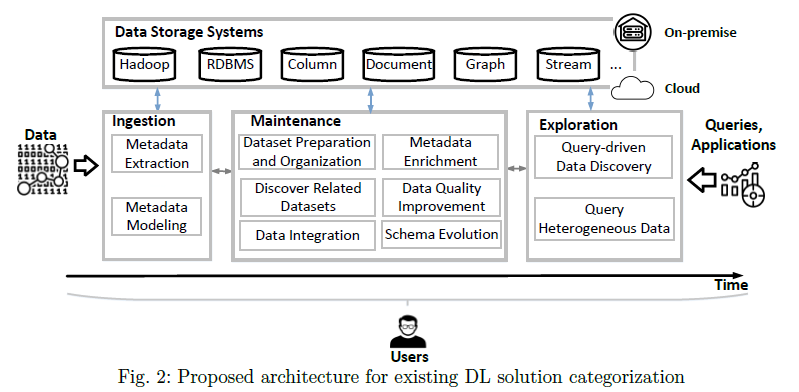
users
- data scientists
- information curators
- the governance, risk, and compliance team
- operations team
5 Storage
preserve the ingested datasets
5.1 File-based storage systems
e.g. HDFS: supports a wide range of files
5.2 Single data store
e.g. Neo4j
has a special application focus on user data of usually relatively small size compared to business scenarios, but higher requirements regarding data privacy
5.3 Polystore systems
e.g. BigDAWG
5.4 Data lakes on clouds
e.g. IaaS
- scale the storage space and computation power dynamically, and in many cases the prices of resources are more economic than on-premises
- the major cloud vendors provide many additional analytics tools in their product portfolio
- relying on a cloud platform also implies risks and challenges in some aspects such as data security, data provenance, and fault tolerance
6 Ingestion
Ingestion components load data into the lake, and store data into databases or file systems
6.1 Metadata extraction
To discovers metadata information that is essential for accessing a dataset
e.g. GEMMS, DATAMARAN, Skluma
6.2 Metadata modeling
To structure and organize the metadata in a formal way
The majority of such models are either logic-based or graph-structured with more or less formal semantics
Generic metadata model
Data vault
Graph-based metadata model
e.g. Aurum
7 Maintenance
To make the data usable the data lake needs to further process and maintain the raw data
7.1 Dataset preparation and organization
structure and navigate the massive heterogeneous datasets in data lakes
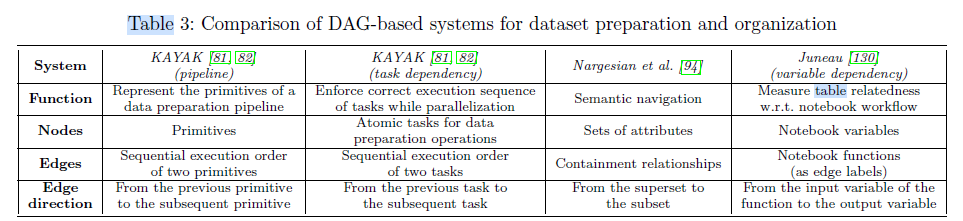
7.1.1 Dataset preparation
e.g. KAYAK
7.1.2 Data lake organization
e.g. GOODS, DS-kNN
data lake organization problem: discovering the optimal structure for users to electively nd the desired dataset in a data lake
7.2 Discover related datasets
data discovery: tries to find a subset of relevant datasets that are similar or complementary to a given dataset in a certain way
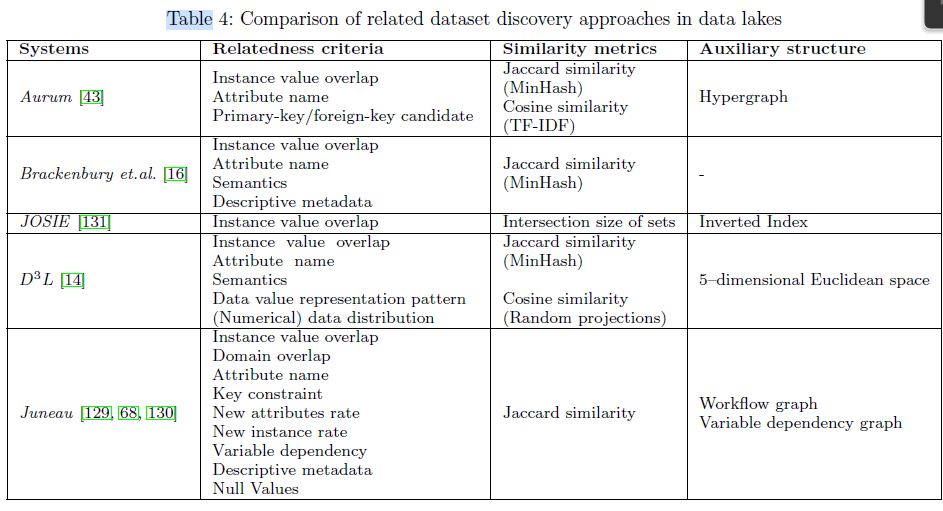
step
- define and extract relatedness signals from tables
- compute multi-dimensional similarities between attributes, and aggregate them to an overall similarity between tabular datasets
7.3 Data integration
To combining multiple heterogeneous data sources and providing unified data access for users
data integration techniques: schema matching, schema mapping, query reformulation, entity linkage
e.g. Constance
7.4 Metadata enrichment
To further understand and explore a dataset
e.g. CoreDB, GOODS, Constance
7.5 Data quality improvement
obtain dependencies from the data in the data lakes, and then use them to improve the data quality.
e.g. CLAMS, Constance
7.6 Schema evolution
handling the changes of schemas and integrity constraints
8 Exploration
challenging:
- a large number of ingested sources
- the heterogeneity of data
solutions:
- discover the data lakes based on the relatedness of datasets
- provide a unified query interface for heterogeneous data sources
8.1 Query-driven data discovery
searching a data lake based on the measured relatedness (e.g., joinable, unionable) among datasets
8.2 Query heterogeneous data
e.g. Constance, CoreDB, Ontario
querying solutions:
- transform the data in heterogeneous NoSQL stores into relational tables and uses an existing relational database to process the data. e.g. Argo
- multistore systems providing a SQL-like query language to query NoSQL systems
- applying a middle-ware to access the multiple NoSQL stores
9 Composite metadata management
To prevent a data lake turn into a “data swamp”
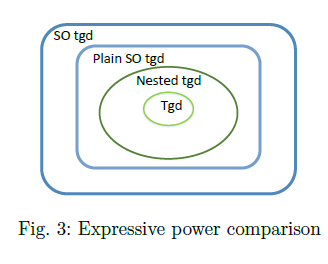
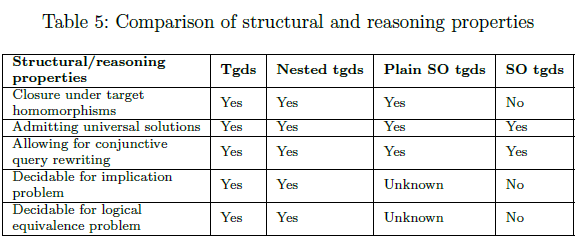
9.1 Schema mapping formalisms
algorithmic properties (computational eficiency)
metadata-related challenges:
- Expressive power
- Structural properties and decidability of reasoning tasks
9.2 Data provenance(data lineage)
the information of data records
10 New directions
- Machine learning in data lakes
- Data lakes for data science
- Stream data lakes
11 Summary and outlook
Some well-studied problems (e.g., data integration, schema evolution, metadata modeling) need new perspectives and methods in data lakes; while many blank spaces (e.g., stream data lakes, integrate data lakes with machine learning and data science) also call for novel solutions.